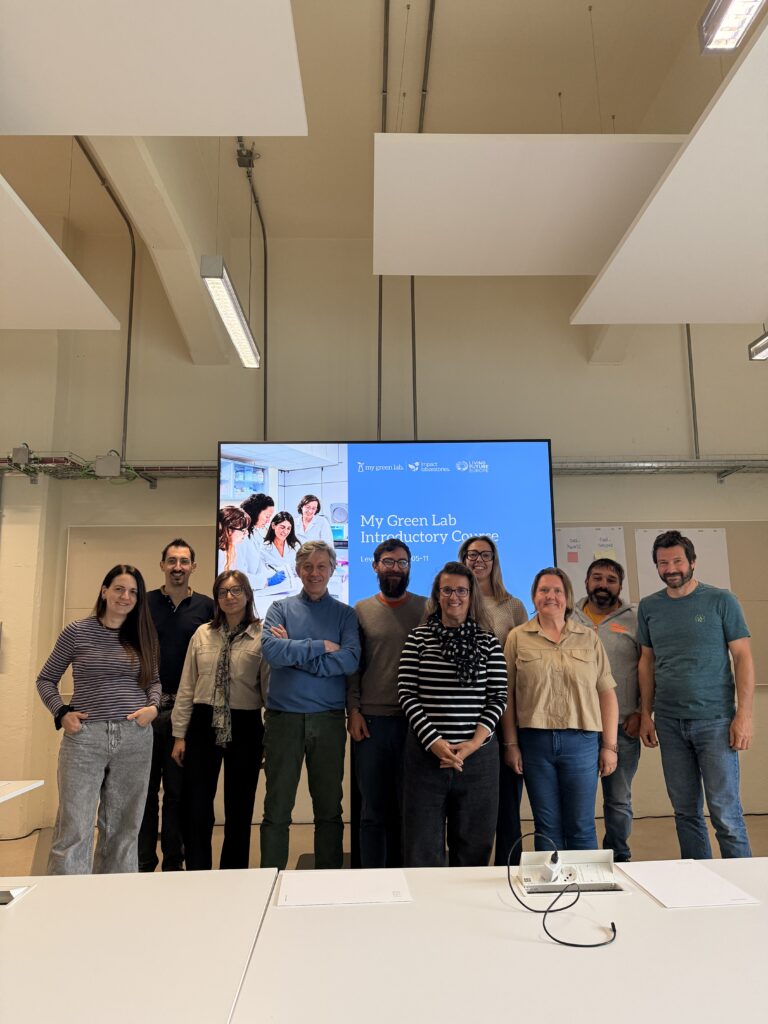
Learning from the past for a better future. The annual PhDay at the Spanish National Centre for Cardiovascular Research – CNIC
The 10th edition of the CNIC PhDay 2024 was hosted on November 29th at the Centro Nacional de Investigaciones Cardiovasculares (CNIC) in Madrid. An annual meeting organized by PhD students and postdoctoral researchers, this year the event delved into the role and impact of science within the environment and society.
LFE’s President Carlo Battisti represented My Green Lab, joining the opening round table on “How to be sustainable in any scientific path”, together with Jane Kilcoyne (Marine Institute of Ireland, Sustainable EU. Lab. Net.), and José Jonay Ojeda (Quality committee IdiPaz). Here are some of the addressed questions and Carlo’s contribution to the conversation.
Based on your background and experience, how would you define sustainability in your workplace and in society as a whole?
Labs are part of the built environment, the largest contributor to GHGs emissions. Our definition of sustainability came out from the work we did in the COST Action RESTORE (2017-2021) as “Limiting impact. The balance point where we give back as much as we take”. The biotech and pharma industry are a significant contributor to global climate change and must therefore be part of the global climate solution. A 2019 study[1] found that the climate footprint of healthcare was two gigatons of carbon dioxide equivalent, representing 4.4% of total global emissions. Of that, 71% of emissions were derived from the healthcare supply chain, which includes the biotech and pharma industry, highlighting the importance of carbon reductions for this specific industry sector. The total carbon emissions in the biotech and pharma sectors (Scopes 1, 2, and 3) reached 397 million tCO2-e in 2023, as per the latest My Green Lab 2024 Carbon Impact of Biotech & Pharma Report.
In your experience, what have been the most positive changes when transitioning to a more sustainable environment in your lab or hospital? If you are with My Green Lab, what positive outcomes have you seen in companies that achieved certification?
Considerable savings in resources consumption have been demonstrated by the labs adopting the My Green Lab Certification process: energy, waste, water, chemical use, and cost savings. The upcoming new MGLC 2.0 version engaged 12 pilot industry labs which achieved savings of 22k$/lab, 5X ROI, 26 CO2 tons/lab in 1 year, including other co-benefits like increased collaboration and engagement, innovation’s promotion, use of healthier materials, public recognition, ultimately positioning these labs as a model for other labs.
What are the main differences between sustainability in your scientific field and in everyday life?
In an ideal work-life balance the two go together and can mutually benefit from each other’s best practices. As scientists spend most of their time working in the lab, this might provide the biggest impact, but sustainability is a matter of continuous choices, thus also what we do in our daily life has an impact. We love the “Trim tab” concept by Richard Buckminster Fuller – what we do as a group has a large impact but also our individual impact matters. “You cannot get through a single day without having an impact on the world around you. What you do makes a difference, and you have to decide what kind of difference you want to make.” – Jane Goodall said
What advice would you give to early-career scientists who want to be sustainable in their work? What skills or experiences are most crucial for them?
Consider becoming a My Green Lab Ambassador – a free, online learning program (now counting almost 8,000 enrolled globally) or even a MGL Accredited Professional (AP) are great options to start with. The My Green Lab Ambassador program provides a quick introduction to lab sustainability, and ideas for how sustainable actions can be implemented and communicated with lab members. The analytical approach that typically early career scientists have is for sure instrumental in addressing sustainability in an effective way.
What lessons do you think your field can learn from other fields to help reduce its carbon footprint or environmental impact?
As I come from the building industry, I learnt how impactful is that sector, and how urgent is the need to implement sustainability on a larger scale. Reducing energy consumption and waste production, decreasing GHGs emissions, avoiding harmful substances, require information transparency, managing the building in an efficient way, and adopting a holistic approach, are all strategies to successfully reduce our carbon and environmental impact. This is also the reason why the UN Road to Zero breakthroughs included My Green Lab as the tool to target the 2050 carbon goal for the life science sector.
In your view, what role should scientists play in addressing the global environmental challenges we face today?
Life science sector could be at the core of the sustainability conversation. Leading by examples, young researchers and scientists can play a fundamental role in demonstrating, disseminating and creating communities of like-minded people, all united for a global goal. Social science research indicates that when 25% of a population adopts a new behaviour, it tends to spread rapidly throughout the rest of the cohort. This is what we could target as a scientific community.
How do you measure or track the sustainability impact of changes in your lab/hospital? Are there specific metrics or tools you find especially useful?
My Green Lab certification and other programs (ACT label, Freezer Challenge) are concrete metrics to measure labs environmental impact. The upcoming MGLC 2.0 will include an Assessment Tool to track progress and manage roadmap, plus an Impact Estimator.
Are there any specific technologies or innovations that have made a noticeable difference in reducing waste or energy use in lab/hospital/industries?
Several case studies are presented on My Green Lab’s “The Beaker” blog, as well as at the monthly MGL Ambassadors meetings. Look at the resources page on My Green Lab website. Here are some “low hanging fruits” that we can pick:
- Make sure lights get turned off in the lab and support rooms, identify equipment to turn off when it is not in use, use outlet timers.
- Chilling up -80s to -70°C can save around 30% of the energy consumed, keep cold storage operating at maximum efficiency.
- Check faucets for low-flow aerators – they can reduce water usage at the tap by 50% – 70%, use alternatives to single-pass cooling like recirculated water or a condenser, run autoclaves and dishwashers when full as much as possible, use the right quality water for the task – it takes 3 litres of water to make 1 litre of DI water.
- Get to know your waste and identify your largest waste streams.
- Work with suppliers to explore product alternatives that can help you minimize waste, reduce hazards and/or decrease energy and water usage.
- Use a shared supply of common reagents and materials to prevent over-purchasing.
- Choose more sustainable products – look for environmental labels like ACT or ENERGY STAR.
What role do you think funding bodies or government policies play in supporting or hindering sustainability efforts in scientific and medical fields?
Set up the regulatory system so that it follows state of the art innovation and sustainability ambition. Lead by example. Produce policies. Fund sustainability-oriented research projects. In alignment with this strategy, My Green Lab and the International Institute for Sustainable Laboratories issued a challenge to science funders around the world to encourage sustainability in research: Million Advocates for Sustainable Science.
How do you think patient care or research quality can be impacted by implementing sustainable practices in a healthcare or lab setting? Can you share any practical or real examples of projects that have addressed sustainability challenges?
Savings obtained by implementing sustainability might help in better funding research and healthcare support. To date, 70 health care institutions representing the interests of 14,000 hospitals and health centres in 26 countries have joined the Race to Zero campaign through Health Care Without Harm. The joint commitment is to more than double the number of health care institutions on a trajectory to net zero health care by 2028 while ensuring access to resilient health care for 100 million people.
Finally, looking to the future, what changes do you hope to see in 10 years within scientific research and industry practices that would significantly advance the global sustainability agenda?
Well, I would like to see the UN Race to Zero campaign fully implemented, with 95% of labs across major pharma and med tech companies My Green Lab certified at the green-level by 2030. To give you some numbers on the mission, to date out of 500,000 labs globally, 3,400 labs engaged with MGL, only a 0.7%. Similarly, out of 8.8 million scientists globally, 40,000 scientists have engaged with MGL certification so fare. only a 0.5%. And out of 2 million lab products, MGL is serving with the ACT label 1,400, only 0.07%. There is a huge potential for improvement and a lot of work to do still! I would also envision much more focus on scope 3 emissions, as well as on the on the indirect impact from life science on other sectors: for instance, let’s consider the transition from in the lab / in vitro experimentation to computational / in silica experimentation through AI & machine learning, which will provide an additional energy consumption burden to be addressed.
PhDay is an open forum for undergraduate and graduate students, lab technicians and postdoctoral researchers to develop their careers as scientists, exchange new ideas and network. Each year, more than 200 people gather at CNIC to share a joyful experience that might generate new ideas and collaborations.
[1] Health Care’s Climate Footprint – Health Care Without Harm in collaboration with Arup (2019)