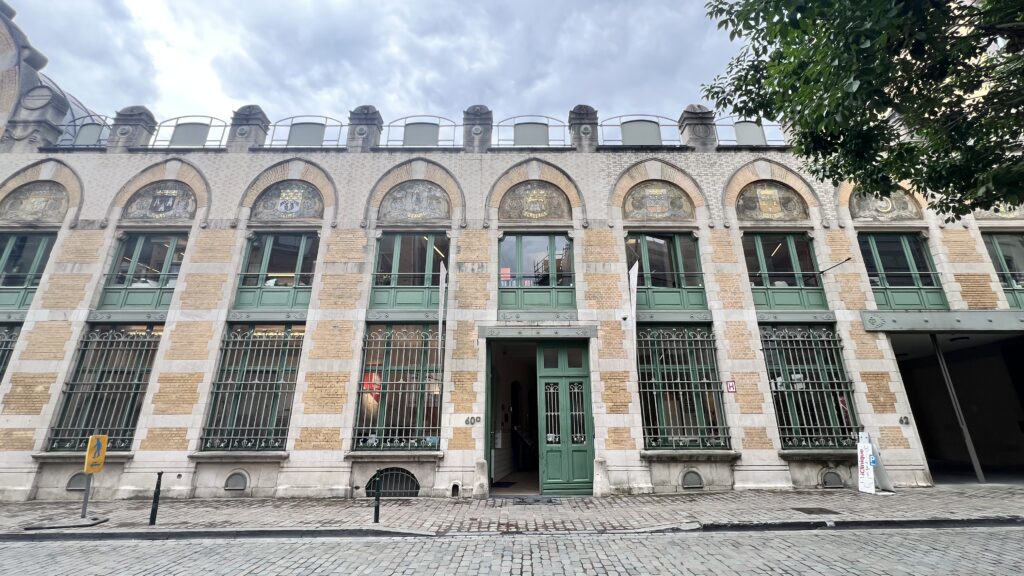
What does it take to move a Zero Carbon ambition from the drawing board to a completed, verified building?
K199 Office Building in Athens offers a useful example. Developed by Noval Property, Greece’s second-largest REIC by portfolio value, the completed project is targeting Living Future Zero Carbon Certification, with Living Future Europe providing advisory support across the certification journey.
With the building now delivered, the project is moving into the operational phase of its Zero Carbon journey, where performance data will support the next stages of the certification process.
For us, K199 is particularly interesting because certification was not treated as an exercise to be completed at the end of construction. Instead, it became a framework connecting design, delivery, building performance and verification.

Photography: Pygmalion Karatzas
Starting with the right pathway
The foundation of any successful certification process is establishing the pathway early.
At K199, our involvement began with the certification kick-off, helping the project team understand the requirements, establish the certification pathway and integrate them into the design process.
This is important because Zero Carbon goes beyond predicted energy efficiency. The framework addresses both operational and embodied carbon, requiring project teams to consider where emissions occur, how they can be reduced, and how performance can ultimately be demonstrated.
The earlier these questions are incorporated into project decision-making, the greater the opportunity to influence outcomes.
From design to delivery
The transition from design into construction is where many sustainability strategies can lose momentum.
Products change. Specifications evolve. Quantities are confirmed. Construction decisions can affect the final carbon profile of a building.
At K199, Living Future Europe supported the project team through this stage with documentation, certification-body coordination and construction support.
This continuity is particularly important for embodied carbon. The certification process requires evidence of the materials and products ultimately incorporated into the building, rather than relying only on early design assumptions.
The objective is therefore not simply to produce a carbon calculation, but to maintain a reliable evidence trail as the project moves from design intent to what is actually built.

Photography: Pygmalion Karatzas
Preparing for performance
With K199 now complete, the project has moved into an important next phase: understanding and documenting the building’s operational performance.
A building can be designed to achieve ambitious energy targets, but its real performance only becomes visible once systems are operating and the building is in use.
At K199, our advisory role includes operations assistance and performance-data tracking, supporting the project team as it prepares for the operational requirements of the certification process.
This is a fundamental distinction in performance-based certification: actual operational data becomes part of the evidence used to demonstrate how the completed building performs. It allows the project team to move beyond modelling assumptions and understand how the completed building is performing in practice.
For us, this is one of the most valuable aspects of the Zero Carbon approach. It creates a feedback loop between design ambition and real-world performance.
Preparing for verification
The next major milestone in K199’s certification journey will be the preliminary audit.
Living Future Europe is supporting the project team in preparing the documentation and evidence required for this stage, as well as coordinating with the certification body as the project moves towards verification.
Independent verification is essential to the credibility of any carbon claim. It is what turns a project’s stated ambition into a demonstrated outcome.
What K199 tells us
K199 demonstrates something that we see increasingly clearly across the projects we support: Zero Carbon is not a label applied to a building at the end of its development. It is a process that needs to be considered across the entire project lifecycle.
That requires technical understanding, but also coordination. Design teams, contractors, operators, owners and certification bodies all contribute to the evidence needed to demonstrate performance.
It also requires a willingness to keep carbon performance visible throughout the project—not only when certification documentation is being prepared.
For Noval Property, K199 provides an opportunity to demonstrate how this approach can be applied to a completed commercial building in the Greek market. For Living Future Europe, it reinforces the value of providing advisory support that connects certification requirements with the realities of design, construction and operation.

Photography: Pygmalion Karatzas
From ambition to verified performance
Zero Carbon projects require more than a strong design concept. They require continuity from early decisions through construction, operation and final verification.
Living Future Europe’s advisory services support project teams throughout this journey — helping establish the right certification pathway, integrate requirements into design and delivery, manage documentation and certification-body coordination, and prepare for performance monitoring and verification.
Whether you are at the beginning of a new project or working to bring a completed building through certification, our advisory team can help translate Zero Carbon requirements into a practical project strategy.
Planning a Zero Carbon project? Talk to Living Future Europe about our advisory services.