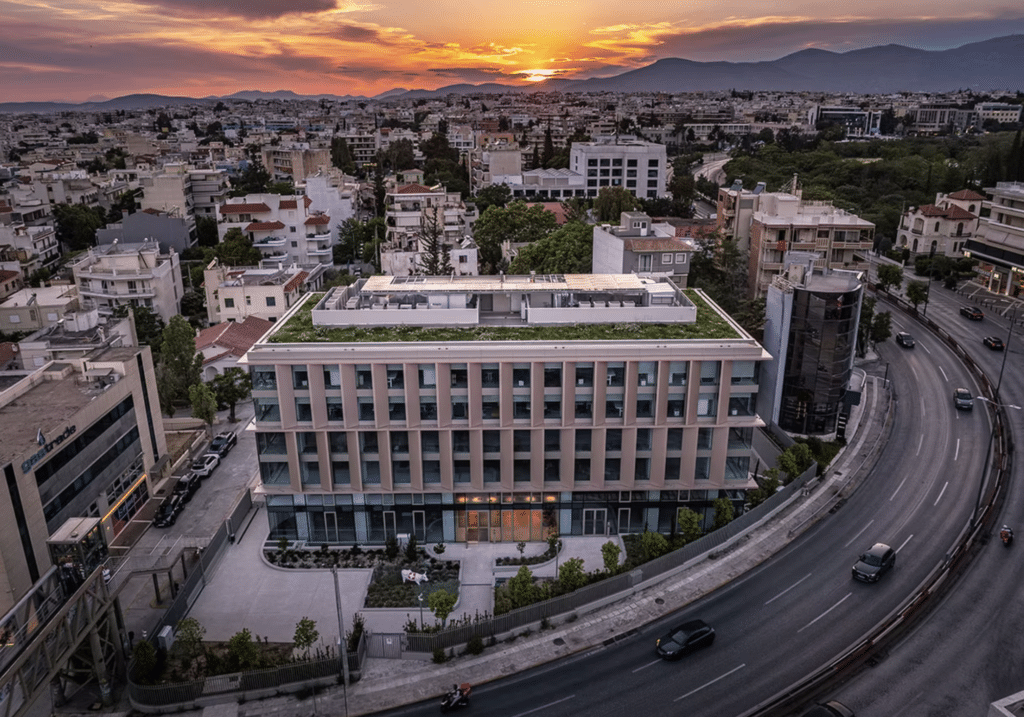
The PAE Living Building in Portland, Oregon, stands as one of the most advanced examples of regenerative design in practice. Fully Living Certified under the Living Building Challenge (LBC), it pushes the boundaries of what’s possible for an urban commercial project, and in particular, it sets a new benchmark for the Water Petal and its Net Positive Water imperative.
Closing the Loop on Water
All potable demand in the building is supplied by harvested rainwater, collected from the roof and stored in a 71,000-gallon cistern. Even before rainwater harvesting, the design achieves a 73% reduction in water demand compared to a code-compliant office building.

Wastewater treatment is equally ambitious. Greywater is reused onsite for flushing and irrigation, while composting toilets on every floor slash the blackwater stream. Where soil and site conditions limit infiltration, resilience is built in: the system can connect to the municipal sanitary system during overflow events, ensuring robustness without compromising performance.
Learning from Experimentation
The Bullitt Centre in Seattle offered a crucial lesson. Conceived as a “giant science experiment,” it pioneered bold new systems, including composting toilets. But over time, operational challenges — unequal waste distribution, limited maintenance flexibility — led to their removal in favour of a vacuum-flush system tied to the municipal sewer.
The PAE team absorbed these lessons and went further. Rather than abandon composting, they reinvented it. The PAE Living Building is the first to implement multistory vacuum-flush composting toilets, combining the water efficiency of vacuum-flush with the nutrient recovery of composting. Waste is evenly distributed across 20 composters, each of which can be rotated or taken offline for maintenance. The system uses 90% less water than conventional toilets and avoids the pitfalls that compromised earlier models.

From Waste to Resource
The project goes beyond simply managing waste — it transforms it into value. Around 8,000 gallons of urine per year are diverted and processed into retail-grade liquid and powder fertilisers, rich in phosphorus and ammonium. The composting itself is a 6–7 month process, completely natural, ensuring that nutrients are safely and effectively cycled back into the environment – the fertilisers are sold to local farmers and gardeners. In this way, the building closes the loop on nutrients, turning what was once a liability into a contribution to local ecosystems and urban agriculture.
A New Standard for Urban Water
If the Bullitt Centre showed that radical experimentation was possible, the PAE Living Building proves that those experiments can evolve into reliable, replicable and scalable systems. By rethinking the entire water cycle — from rain to reuse, from waste to fertiliser — it demonstrates how regenerative design can thrive at scale in the urban environment.
More than a building, the PAE Living Building is a blueprint for Net Positive Water in the cities of tomorrow.