Planetary boundaries are a framework to describe limits to the impacts of human activities on the Earth system, published by Stockholm Resilience Centre, Stockholm University.
They were first proposed by Johan Rockström, co-founder and professor at the Stockholm Resilience Centre, and a group of 28 internationally renowned scientists in 2009.
They are interdependent, meaning that if we cross one Boundary, we will affect others, or even cause them to cross out of the safe operating space.
Boundaries are interrelated processes within the complex biophysical Earth system. We cannot consider Planetary Boundaries in isolation in any decision making on sustainability. Only by respecting all nine boundaries can we maintain the safe operating space for human civilization.
Crossing boundaries increases the risk of generating large-scale abrupt or irreversible environmental changes. Drastic changes will not necessarily happen overnight, but together the boundaries mark a critical threshold for increasing risks to people and the ecosystems we are part of.
In September 2023, the team quantified, for the first time, all nine processes that regulate the stability and resilience of the Earth system. Six boundaries are now transgressed and pressure is increasing on all boundary processes except ozone depletion.
The nine planetary boundaries and their status:
- Climate change: transgresseed.
- Novel entities: currently, the amount of synthetic substances released into the environment without adequate testing is above the safe level.
- Stratospheric ozone depletion: the current total amount of stratospheric ozone is within safe levels, and recovery is ongoing, with values still below mid-20th century levels.
- Atmospheric aerosol loading: the interhemispheric difference in atmospheric aerosol loading is within the Safe Operating Space.
- Ocean acidification: the current aragonite saturation state, is within the Safe Operating Space but is close to crossing the safe boundary.
- Modification of biogeochemical flows: both the global phosphorus flow into the ocean and the industrial fixation of nitrogen (extracting nitrogen from the atmosphere), are disrupting the corresponding nutrient cycles beyond the safe level.
- Freshwater change: human-induced disturbances of both blue water (e.g. rivers and lakes) and green water (i.e. soil moisture) have exceeded the safe level.
- Land system change: the remaining forest areas in all three biomes (tropical, boreal, and temperate) have fallen below the safe levels.
- Biosphere integrity: both the loss of genetic diversity, and the decline in the functional integrity of the biosphere, have exceeded their safe levels.
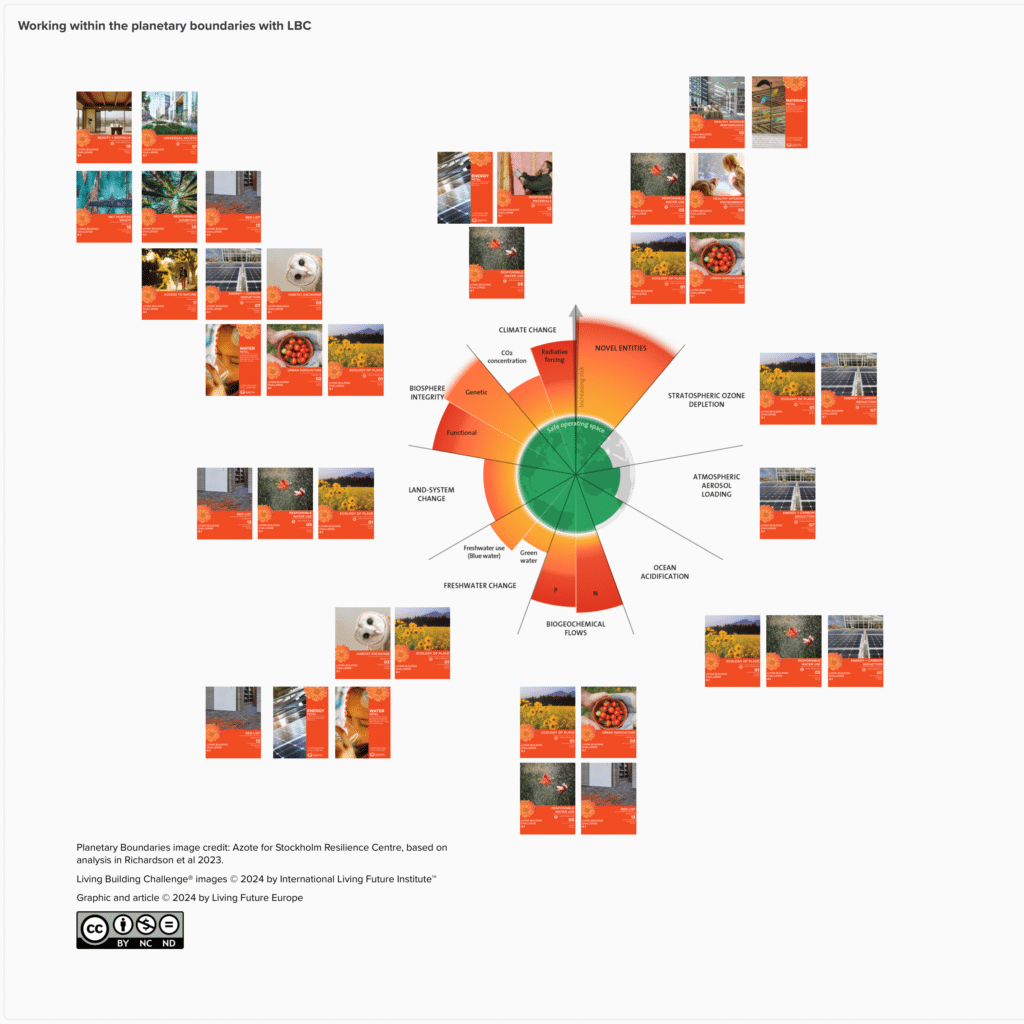
The Living Building Challenge can be directly linked to the Planetary Boundaries, as it effectively mitigates negative impacts and promotes regenerative practices. The Technical Advisory Group (TAG) at Living Future Europe has been working to examine the Planetary Boundaries framework and assess the positive contributions of the Living Building Challenge to each boundary. This includes an evaluation of the tools and strategies provided by the LBC and their role in mitigating pressures on these critical environmental thresholds. A ‘crosswalk’ table outlines each of the Planetary Boundaries and their relationship with the imperatives of each LBC Petal. It explains the imperative’s objective and requirements, and how they align with the respective Planetary Boundary.
Planetary Boundaries and Living Building Challenge Alignment
Climate Change The LBC aids in mitigating climate change by promoting energy-efficient designs, renewable energy sources, water conservation strategies, and the use of regenerative materials. Its commitment to net-zero carbon emissions across all stages of a building’s lifecycle exemplifies systemic approaches to carbon reduction, aligning with the urgency to reduce the harm of this already transgressed boundary.
Novel Entities The LBC minimizes the impact of synthetic chemicals and harmful substances (e.g. microplastics, endocrine disruptors, organic pollutants) by adhering to its Red List, which identifies and prohibits hazardous materials. By prioritizing non-toxic, renewable, and circular materials, the LBC supports a future where the proliferation of harmful human-made chemicals is curtailed, ensuring alignment with this critical planetary boundary.
Atmospheric Aerosol Loading Through clean energy adoption and strategies for reducing greenhouse gas emissions, the LBC contributes to preserving the stratospheric ozone layer and minimizing aerosol emissions. Its regenerative principles inherently support atmospheric health, demonstrating a proactive stance against these boundaries.
Ocean Acidification The principles of the LBC address ocean acidification by targeting the root cause of decreasing pH: excessive atmospheric CO₂ absorption. Ocean Acidification harms calcifying organisms, impacting marine ecosystems. By fostering carbon neutrality, sustainable resource use, and ecosystem restoration, LBC projects not only reduce CO₂ emissions but also encourage the protection of marine biodiversity, aiding global efforts to maintain safe ocean pH levels. This planetary boundary is close to crossing the Safe Operating Space threshold and therefore demands urgent attention.
Biogeochemical Flows The global phosphorus flow into the ocean and the industrial fixation of nitrogen (extracting nitrogen from the atmosphere), are disrupting the corresponding nutrient cycles beyond the safe level. Through regenerative agriculture, adaptive landscaping, and closed-loop water systems, LBC buildings reduce reliance on industrial nitrogen fixation and phosphorus fertilizers. These strategies support healthy nutrient cycles, mitigating disruptions to this boundary.
Freshwater Use The LBC aligns with the freshwater boundary by enhancing water efficiency and avoiding toxic chemicals in materials. Nature-based solutions, such as gray and black water recycling and habitat preservation, safeguard natural freshwater cycles. Key strategies include eliminating waste in water transmission systems, implementing closed-loop water management, and ensuring that freshwater use is in balance with natural replenishment rates. By selecting materials with low embodied water and encouraging innovative water capture methods, such as rainwater harvesting and aquifer recharge, the LBC fosters a sustainable water economy. Moreover, its focus on habitat exchange ensures the protection and restoration of ecosystems, which play a vital role in maintaining freshwater availability and quality. These comprehensive measures not only reduce human interference in freshwater systems but also support the resilience of aquatic and terrestrial habitats.
Land-System Change The transformation of natural landscapes by human development diminishes ecological functions like carbon sequestration, moisture recycling, and habitats for wildlife. Promoting sustainable land use, biodiversity conservation, and ecosystem restoration, the LBC reduces the impact of deforestation, urbanization, and soil degradation. These measures directly address the land-system change boundary, advocating for balanced human development within ecological limits.
Biosphere Integrity LBC’s imperatives on ecological regeneration, habitat exchange, and biodiversity enhancement underscore its alignment with maintaining biosphere integrity. By ensuring projects avoid pristine habitats and contribute positively to local ecosystems, the LBC supports the resilience of global carbon cycling and ecosystem health. Habitat exchange, a core tenet of the LBC, safeguards equivalent areas of land to offset development impacts, ensuring the preservation of critical habitats. This approach bolsters the health of ecosystems and strengthens biodiversity, addressing the interconnected challenges of species loss and ecological degradation. Additionally, the emphasis on restoring degraded lands and mimicking natural habitat functionality enhances the ability of ecosystems to regulate planetary systems effectively.
Conclusion
The Living Building Challenge and the Planetary Boundaries framework share a vision of ecological resilience and regeneration. By addressing critical environmental thresholds through innovative and restorative building practices, the LBC exemplifies how the built environment can lead the shift from merely minimizing harm to actively fostering planetary health. This alignment not only demonstrates the transformative potential of regenerative design but also emphasizes the interconnectedness of human activities and Earth’s ecological systems.
Request the “Design + Build within the Planetary Boundaries with LBC” table
[Cover image: ActionVance on Unsplash]