Turbulent times require responsible and well-intentioned leaders, with a clear direction to take – one that, for all of us living in the built environment, must follow a regenerative path.
It seems that everything is being called into question, starting with the commitment to a more equitable and sustainable global future. The new US administration is backtracking on the Paris Agreement and banning a series of words that are precisely the indicators of the socially just, culturally rich, and ecologically regenerative communities we at Living Future Europe strive for every day.
It appears that the European Union – which just over five years ago declared its ambition to become the first carbon-neutral continent (speech by President-elect von der Leyen in the European Parliament Plenary, 27 November 2019) – is now giving in to lobbying efforts that aim to weaken the Green Deal’s effectiveness, through the ‘Omnibus’ packages.
And this, just days before we commemorate the legacy of Pope Francis’ encyclical Laudato Sì – published shortly before his passing – whose core message remains the profound interconnection between the environmental crisis of the Earth and the social crisis of humanity: integral ecology.
Nevertheless, the global ecological crisis continues to accelerate. We know exactly what must be done, but are we truly doing it?
The Same Old Problem
Buildings account for 40% of total energy consumption in the EU and 36% of its energy-related greenhouse gas emissions, while 75% of buildings remain energy-inefficient. Construction and demolition waste represent around 32% of total waste generated. Residential buildings, manufacturing, and construction account for 29% of water consumption. Finally, the built environment sector is responsible for nearly 30% of global biodiversity loss.
Beyond the physical footprint, construction is the largest industrial sector globally and among those at the highest risk of forced labour. In the UK, working on a building site has become the deadliest profession.
Despite decades of impact reporting, strategy development, training on impact reduction, legislation, and the efforts of the green building movement, the built environment sector – including suppliers, designers, constructors and managers – is simply not making meaningful progress on the sustainability agenda. The sector continues to rely on a business-as-usual approach, focusing primarily on minimising harm, thus reinforcing a degenerative narrative. The building industry remains linear, inefficient, and unjust, contributing significantly to climate change and environmental degradation.
‘Green’ has proved insufficient. ‘Sustainable’ is the bare minimum – and in truth, most of our design and building practices have yet to meet even that standard. ‘Regenerative’ offers a pathway forward: a holistic approach that not only addresses these systemic challenges but actively contributes to healing our planet and society.
We envision a regenerative Europe in which the built environment enables thriving ecological and social systems.
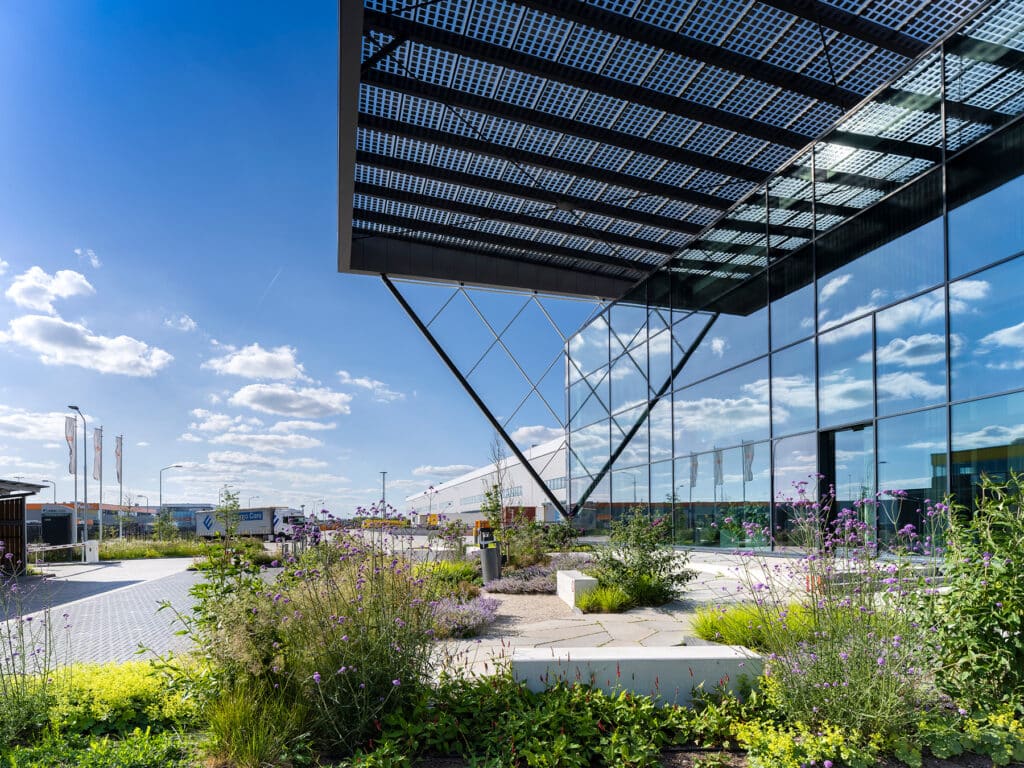
Through our regenerative approach to buildings, products, organisations, and communities, we can shape a radically different built environment: one made up of buildings that generate more energy than they consume, capture and treat all water on-site, are constructed with healthy materials under socially just and equitable conditions, reconnect occupants with nature, and are beautiful. Ultimately, these buildings offer positive contributions to the environment, health, equity, and financial perspectives – all demonstrated through their measurable performances.
Our Value Proposition
Living Future Europe shows developers how to significantly increase profits, eliminate carbon pollution, improve occupant health and happiness, reduce compliance risks, and deliver a range of substantial social and economic benefits to the community – far beyond what traditional building standards can achieve.
With 800 projects globally covering over 5,000,000 sqm, the global Living Future movement has demonstrated that transforming buildings from harmful legacy design to regenerative design can reduce CO2 emissions to zero, increase occupants’ wellbeing by 15%, boost productivity by 6%, and offer up to a 30% return on investment – not to mention the positive impact on local ecosystems and communities.
In Europe alone, we are already seeing signs of this paradigm shift: around 50 regenerative building projects and 200 ‘positive’ buildings or furniture products have been registered, labelled or certified under one or more of the Living Future standards.
If all buildings in Europe were designed and built this way, it would support the continent’s long-term strategy to become the world’s first climate-neutral region by 2050. It would also enable major corporations and organisations to offset their Scope 1 CO2 emissions. Furthermore, it would align with the booming wellness trend, a €1.8 trillion global market in 2024, and could generate an estimated €1.3 trillion increase in GDP.
Our Ambition for the Next Decade
Over the next decade, we envision a paradigm shift in Europe’s built environment – moving from merely ‘doing less harm’ to actively ‘doing more good’. Our goal is to grow the adoption of regenerative practices in the European building industry from today’s barely visible niche to 16% by 2034.
How We Will Get There: The LFE 2025–2027 Strategic Plan
We’re excited to announce that the Living Future Europe 2025–2027 Strategic Plan is now available for download.
In this new roadmap, we reflect on our wins in the first five years of our operation, and the challenges that lie ahead, especially as the building sector continues to exert a significant and unresolved impact on both our ecological and social systems.
The plan outlines how a regenerative design approach for buildings, products, and communities can offer a real solution. It demonstrates how this approach supports Europe’s long-term climate strategy and helps organisations align with the European Climate Law.
Partner with us to invest in your regenerative future – find out how!
xxxx