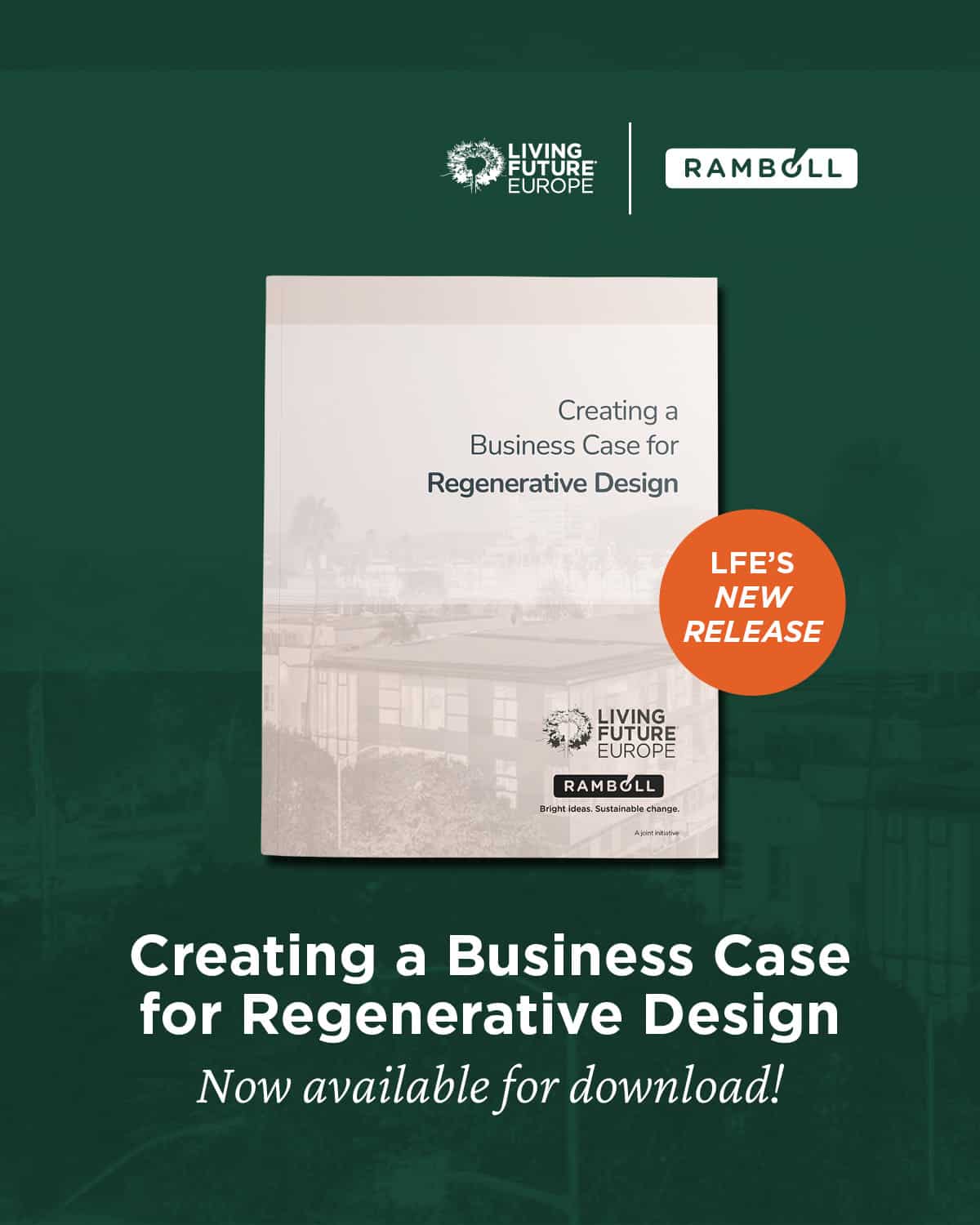
Living Future Europe and Ramboll have released a new publication exploring how regenerative approaches in the built environment can generate measurable financial, social, human, and ecological value.
Creating a Business Case for Regenerative Design combines practitioner insight with international case studies to examine how regenerative design can move beyond sustainability compliance toward long-term resilience, ecosystem restoration, and future-aligned asset performance.
Developed through a collaborative research initiative graciously funded by the Ramboll Foundation, the publication responds to one of the key barriers facing regenerative development today: the perception that regenerative approaches carry excessive cost and risk.
The report demonstrates that regenerative design can create value through:
- lower operational and lifecycle costs
- increased resilience and reduced future risk
- improved occupant well-being and productivity
- biodiversity and ecosystem enhancement
- stronger social and civic outcomes
Structured around five interconnected themes — Financial Value Creation, Financial Value Protection, Social Value Creation, Human Value Creation, and Nature Value Creation — the publication offers a practical framework for translating regenerative outcomes into decision-relevant and investable metrics.
The research draws on international case studies including the Bullitt Center, the Kendeda Building for Innovative Sustainable Design, Prologis DC4, the PAE Living Building, and the Santa Monica City Services Building, demonstrating how regenerative principles can be applied across multiple building typologies, climates, and ownership models.
At Living Future Europe, we believe regenerative design represents a critical shift in how we approach the built environment — moving beyond “doing less harm” toward creating places that actively support ecological health, human well-being, and long-term resilience.
This publication contributes to a growing evidence base showing that regenerative approaches are not only environmentally necessary, but increasingly strategic and economically relevant within evolving market and regulatory conditions.
We would like to thank all authors, contributors, collaborators, and partner organisations involved in this work, including Ramboll, the Ramboll Foundation, the International Living Future Institute, and the featured project teams.
Read the full publication here.