
From Neutrality to Wellbeing: The New Frontier of Construction
By Alexis Paparo | 14 July 2025 | Il Sole 24 ORE
“Green building is dead. Long live green building.” These provocative thoughts come from Carlo Battisti, president of Living Future Europe, the European affiliate of the International Living Future Institute, based in Bolzano. It marks a turning point in the debate on sustainable construction.
“We’ve demonstrated that carbon-neutral buildings are possible — but that’s no longer enough,” Battisti explains. “The next step is designing spaces that have a positive environmental and social impact, becoming active creators of wellbeing, biodiversity, and resilience.”
Living Future Europe offers several types of certification, with the Living Building Challenge (LBC) at the top — the world’s most rigorous and ambitious sustainable building standard, launched in 2006. Today, it counts 130 certified buildings worldwide and around 200 more under development. The certification applies to new constructions, existing buildings, and interior projects, requiring that buildings meet seven performance areas: Place; Water; Energy; Health and Happiness; Materials; Equity; and Beauty.
The Zero Carbon Certification, by contrast, “has about twenty structures worldwide and approximately 160 under construction. The goal is to calculate the building’s life cycle impact (through an LCA) to minimise its carbon footprint—both embodied and operational—and offset it. For many investors, developers, and design firms today, carbon neutrality is the new energy efficiency,” Battisti continues.
Unique in the industry, all LFE certifications are awarded after the building is occupied and monitored for 12 consecutive months to confirm actual performance. An independent auditor then verifies compliance.
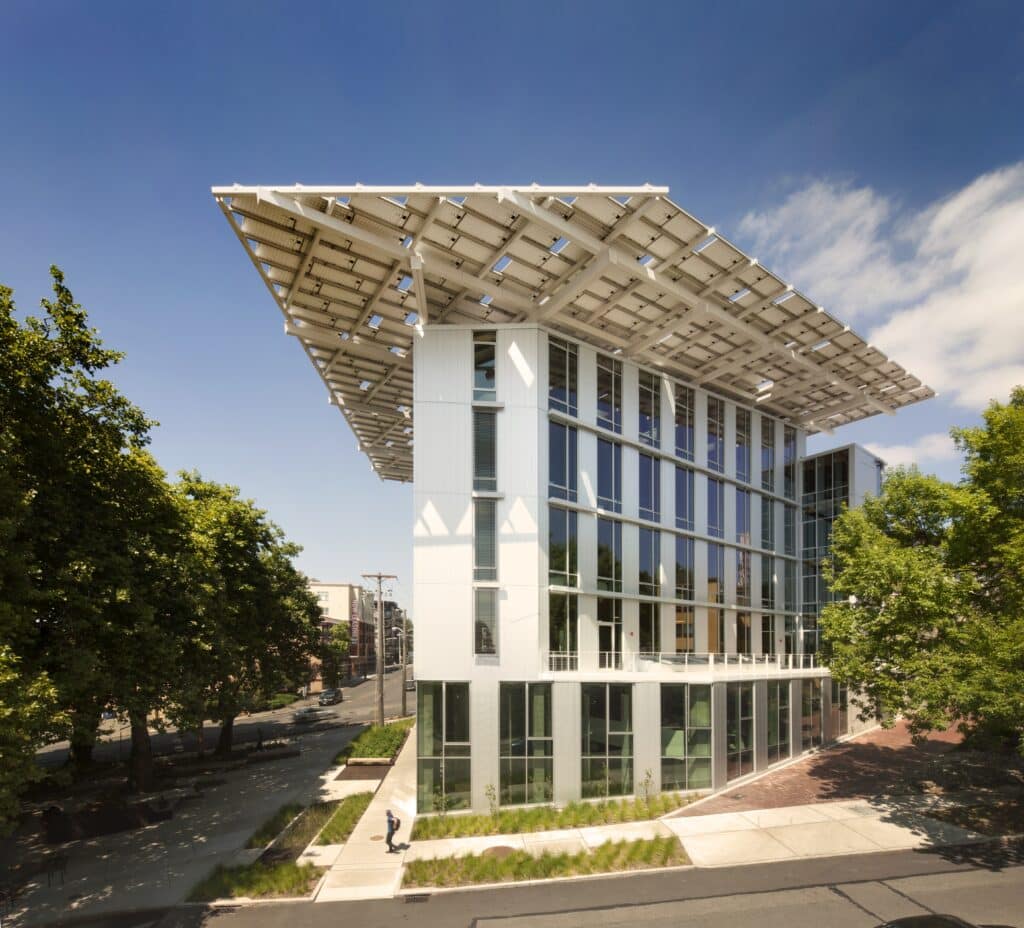
Examples range from Google’s London HQ to Prologis Logistics Centre in Eindhoven, and the first Living Building Challenge residential building in the Pyrenees. The Bullitt Center in Seattle, opened in 2013, was the first commercial building to receive LBC certification. It generates 60% more energy than it consumes and uses only rainwater, thanks to a water treatment plant that also includes on-site greywater filtration. The total cost was $32.5 million for 4,800 m². Despite higher-than-average upfront costs — which could now be significantly reduced — the generated environmental and social benefits (over $18 million estimated for the building’s lifecycle) make the model replicable.
Certified in 2024, the PAE Living Building in Portland is now the largest commercial building to meet the LBC standard, covering over 5,300 m² across six floors. It used only impact-positive materials, reused 98% of site materials, and produces 108% of its energy needs and 100% of its water needs via rainwater collection and treatment. Biophilia is integrated into interior design, and one of its terraces hosts a vegetable garden.
“The technologies already exist, and many players in the construction sector are moving in this direction,” says Battisti. “The real obstacle is a shift in mindset.”
In Italy, the process is still in its infancy, but the potential is enormous. “We have the resources; we just need the willingness to take risks and innovate,” he concludes.